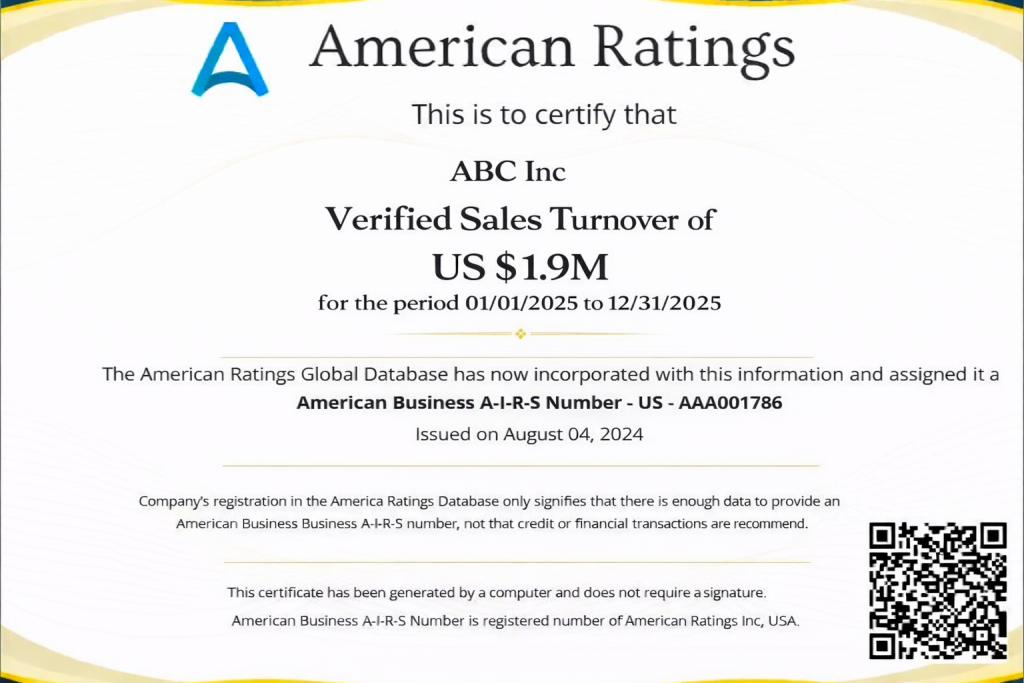
American Ratings – Turnover Certificate: Meaning, Importance, Uses Across Industries & How Businesses Obtain It
Introduction
In today’s regulated and credibility-driven business environment, documentation is no longer optional—it is essential. One such critical document increasingly demanded by banks, investors, government authorities, vendors, and global partners is the Turnover Certificate.
Whether you are a startup, MSME, exporter, manufacturer, service provider, or a large enterprise, a Turnover Certificateacts as official proof of your business’s financial scale and operational credibility. Across industries and geographies, it is now a key requirement for compliance, verification, funding, and trust-building.
This article explains what a Turnover Certificate is, why it is required, who needs it, how it is used across industries, and how businesses can obtain a professionally validated Turnover Certificate for domestic and international purposes.
What Is a American Ratings Turnover Certificate?
A Turnover Certificate is an official document that certifies the annual sales turnover of a business for a specific financial period. It confirms the revenue generated by an organization and serves as authenticated financial evidence.
Unlike internal financial statements, a Turnover Certificate is issued or validated by an independent, recognized authority, making it acceptable to third parties such as banks, government bodies, corporates, and international stakeholders.
Key Information Typically Included
- Legal name of the business
- Business registration details
- Financial year(s) covered
- Certified sales turnover amount
- Currency and valuation method
- Issuing authority details
- Verification reference or certificate number
Turnover Certificate vs Financial Statements
Many businesses confuse a Turnover Certificate with documents like balance sheets or profit & loss statements. However, they serve different purposes.
Financial StatementsTurnover CertificateInternal accounting documentsThird-party validationPrepared by company or auditorIssued by recognized authorityUsed for internal reviewUsed for external verificationNot always accepted externallyWidely accepted for compliance
A Turnover Certificate simplifies decision-making for external parties by providing clear, concise, and verified turnover proof.
Why Is a Turnover Certificate Important?
The importance of a Turnover Certificate lies in trust and compliance. Across sectors, organizations are required to demonstrate financial capacity before being approved for opportunities.
Common Reasons Businesses Need a Turnover Certificate
- Bank loans and credit facilities
- Government tenders and contracts
- Vendor registration and onboarding
- Corporate partnerships
- Export–import documentation
- Investor due diligence
- Franchise and dealership approvals
- International business verification
In many cases, applications are rejected outright if a valid Turnover Certificate is not provided.
Industries That Require Turnover Certificates
A Turnover Certificate is not limited to one sector. It is used across industries, including but not limited to:
1. Manufacturing & Industrial Units
- Vendor qualification
- Government procurement
- Machinery financing
2. IT, Software & Technology Companies
- Enterprise client onboarding
- SaaS partnerships
- Global service contracts
3. Trading, Wholesale & Distribution
- Supplier approvals
- Credit limits
- Import–export clearances
4. Construction & Infrastructure
- Tender eligibility
- EPC contracts
- Project financing
5. Healthcare, Pharma & Medical Devices
- Hospital vendor registration
- Regulatory submissions
- International trade
6. Education & Training Institutions
- Grants and funding
- Corporate collaborations
- International affiliations
7. Startups & MSMEs
- Incubator and accelerator programs
- Government schemes
- Angel and VC evaluation
8. Professional Services
- Consulting engagements
- Large corporate empanelment
- Global client onboarding
Turnover Certificate for Banks and Financial Institutions
Banks often demand a Turnover Certificate for:
- Working capital limits
- Overdraft facilities
- Term loans
- Trade finance
Banks rely on this certificate to quickly assess repayment capacity without analyzing full financial statements line by line.
Turnover Certificate for Government Tenders
Government and PSU tenders frequently specify minimum turnover criteria. A Turnover Certificate:
- Confirms eligibility
- Avoids disqualification
- Strengthens bid credibility
Without it, even technically qualified bids may be rejected.
Turnover Certificate for International Business
For global trade, foreign partners often need neutral, third-party confirmation of a company’s financial standing.
A Turnover Certificate helps with:
- Overseas vendor approvals
- Cross-border partnerships
- International compliance
- Risk assessment
This is especially important when dealing with entities unfamiliar with local financial formats.
Turnover Certificate for Startups and Growing Businesses
Contrary to popular belief, startups also benefit from Turnover Certificates.
Uses include:
- Investor discussions
- Corporate pilots
- Enterprise contracts
- Credibility building
Even moderate turnover, when professionally validated, significantly increases trust.
How Is Turnover Calculated?
Turnover generally refers to:
- Gross sales or revenue generated
- Excluding taxes such as GST/VAT (unless specified)
- Based on audited or declared financial data
The calculation method must be transparent and consistent with applicable accounting standards.
Who Can Issue a Turnover Certificate?
Traditionally, Turnover Certificates were issued by:
- Chartered Accountants
- Auditors
However, modern business requirements often demand:
- Faster issuance
- Global acceptability
- Standardized validation
As a result, businesses increasingly rely on independent rating and verification organizations that specialize in business credentials and certifications.
Benefits of a Professionally Issued Turnover Certificate
A professionally issued Turnover Certificate offers:
- Higher acceptance across institutions
- Neutral, third-party validation
- Faster approval cycles
- International usability
- Digital verification options
This reduces friction in business processes and improves deal conversion.
Common Mistakes Businesses Make
- Submitting internal documents instead of certified proof
- Using outdated turnover figures
- Providing inconsistent financial data
- Relying on non-verifiable certificates
- Ignoring global compliance requirements
Avoiding these mistakes saves time and prevents rejections.
How to Choose the Right Turnover Certificate
When selecting a Turnover Certificate solution, businesses should ensure:
- Recognized issuing authority
- Clear validation process
- Secure verification reference
- Acceptance across industries
- Scalability based on turnover size
The certificate should support small, medium, and large enterprises alike.
Turnover Certificate and Business Credibility
In many cases, a Turnover Certificate acts as a first filter. Before meetings, site visits, or audits, stakeholders want immediate confidence.
A verified Turnover Certificate:
- Positions your business as transparent
- Signals operational maturity
- Reduces perceived risk
This often accelerates negotiations and approvals.
Digital Turnover Certificates: The Future
With businesses operating globally, digital Turnover Certificates are becoming the norm.
Advantages include:
- Faster issuance
- Online verification
- Secure storage
- Easy sharing with stakeholders
Digital certificates also align with modern compliance and data security standards.
Final Thoughts
A Turnover Certificate is more than just a financial document—it is a trust instrument. Across industries, markets, and geographies, it enables businesses to prove credibility, meet compliance requirements, and unlock growth opportunities.
As regulatory scrutiny increases and business decisions become more data-driven, having a professionally validated Turnover Certificate is no longer optional—it is strategic.
Businesses that proactively obtain and maintain accurate Turnover Certificates position themselves ahead of competitors, reduce friction in approvals, and build long-term credibility in domestic and international markets.
Leave a Reply