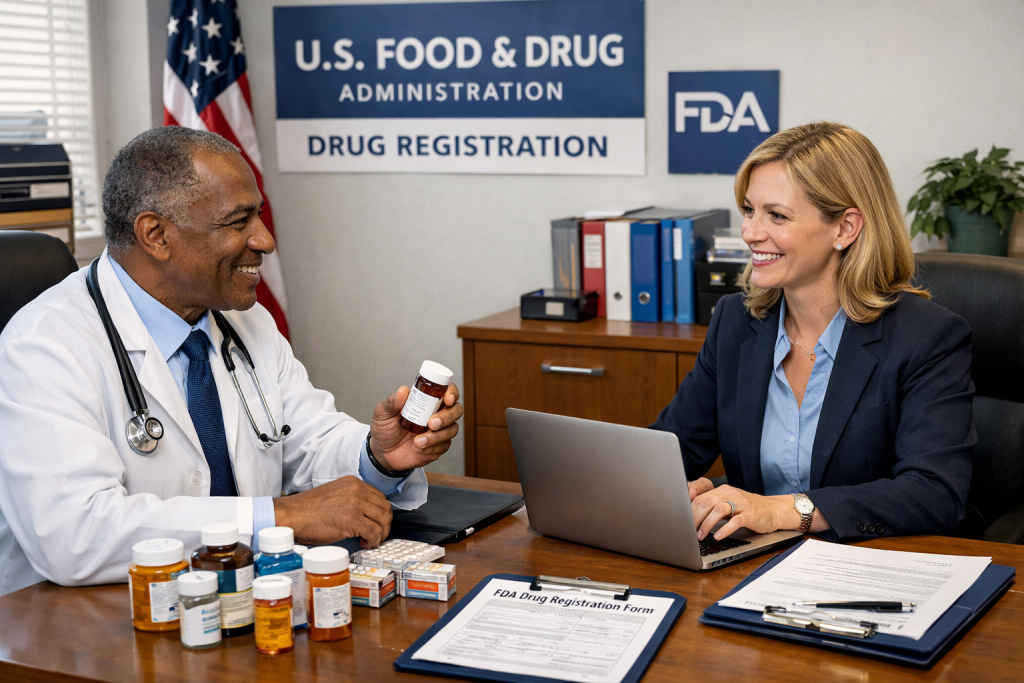
US FDA drug registration is a mandatory regulatory requirement for organizations involved in the manufacturing, processing, packing, holding, or marketing of drug products regulated by the U.S. Food and Drug Administration. This framework is designed to ensure that drug products meet established standards of safety, quality, effectiveness, and labeling accuracy throughout their lifecycle.
XPRO America is a US FDA Consultancy providing comprehensive US FDA drug registration services globally. Our role is to simplify regulatory complexity while ensuring full compliance at every stage. For expert assistance, contact support@xproamerica.com.
Understanding US FDA Drug Registration
US FDA drug registration is not a single approval step. It is a structured regulatory system that includes establishment registration, drug listing, regulatory submissions where applicable, and continuous compliance obligations. Any facility engaged in drug-related activities must maintain an active registration, and every commercial drug product must be properly listed with accurate details.
This system enables US FDA to maintain oversight of manufacturing sites, evaluate regulatory risk, conduct inspections, and ensure traceability across the global drug supply chain.
What Is US FDA Drug Establishment Registration
US FDA drug establishment registration is the annual registration of facilities involved in manufacturing, processing, packing, labeling, or holding drug products. Registration creates a formal regulatory identity for the facility and allows US FDA to plan inspections and monitor compliance status.
Establishment registration must be renewed annually. Failure to renew or maintain accurate facility information can result in regulatory action, even if the drug product itself meets quality standards.
US FDA Drug Listing Explained
US FDA drug listing is the submission of detailed information for each commercial drug product associated with a registered establishment. Drug listing includes dosage form, route of administration, formulation details, labeling content, and manufacturing site information.
Listings must remain current at all times. Any change in formulation, labeling, or manufacturing location requires timely updates to ensure continued compliance and avoid regulatory discrepancies.
Regulatory Pathways Under US FDA
US FDA regulates drugs through different regulatory pathways depending on product type, intended use, and risk profile. Some drugs require extensive scientific review supported by non-clinical and clinical data, while others follow standardized compliance pathways based on established requirements.
Selecting the correct regulatory pathway is critical. An incorrect pathway can lead to delays, additional data requests, or rejection. Strategic regulatory planning at the early stage of US FDA drug registration significantly improves approval timelines and reduces regulatory risk.
Core Requirements for US FDA Drug Registration
The core requirements for US FDA drug registration include active establishment registration, accurate drug listing, compliance with current good manufacturing practices, validated quality systems, and compliant labeling. US FDA places strong emphasis on documentation accuracy, data integrity, and consistency across all regulatory records.
Depending on the drug category, additional requirements may apply, such as stability data, safety documentation, or effectiveness evidence to support approval or compliance.
Role of US FDA Inspections and GMP Compliance
US FDA inspections are conducted to verify compliance with current good manufacturing practices. Inspectors evaluate facility controls, production processes, quality management systems, validation activities, personnel training, and documentation practices.
Inspection readiness is a continuous responsibility. US FDA expects companies to maintain compliance throughout the product lifecycle, not only during initial registration or approval. Inspection findings can directly impact registration status, product continuity, and regulatory credibility.
Timelines and Review Considerations
US FDA review timelines vary based on submission type, product complexity, and the quality of documentation provided. While standard review targets exist, actual timelines depend on how effectively regulatory expectations are met.
Incomplete submissions, inconsistent data, or delayed responses to regulatory queries often extend review cycles. Well-prepared submissions supported by regulatory expertise improve predictability and reduce compliance risk.
Post-Registration and Ongoing Compliance Obligations
US FDA drug registration is an ongoing process. Companies must renew establishment registration annually, maintain accurate drug listings, manage adverse event reporting, implement change control procedures, and remain inspection ready at all times.
Any post-registration changes to formulation, manufacturing process, or labeling must be evaluated for regulatory impact and submitted to US FDA as required. Failure to manage post-registration obligations can lead to enforcement action or disruption of commercial activities.
Common Challenges in US FDA Drug Registration
Organizations frequently encounter challenges such as incorrect regulatory pathway selection, documentation gaps, weak quality systems, and inadequate inspection preparedness. These issues can delay market entry, increase regulatory scrutiny, and raise compliance costs.
Engaging experienced regulatory professionals helps mitigate these risks by ensuring technical accuracy, strategic alignment, and proactive compliance management.
How XPRO America Supports US FDA Drug Registration
XPRO America is a US FDA Consultancy offering end-to-end US FDA drug registration services globally. Our support includes regulatory pathway assessment, establishment registration, drug listing, documentation preparation, GMP readiness, inspection support, and lifecycle compliance management.
We act as a single regulatory partner, enabling organizations to achieve and maintain compliance while focusing on long-term regulatory sustainability. For professional guidance, contact support@xproamerica.com.
Conclusion
US FDA drug registration is a complex yet essential regulatory requirement for organizations involved in drug manufacturing and marketing. It requires strategic planning, technical precision, and continuous adherence to regulatory expectations throughout the product lifecycle.
With the right regulatory strategy and expert support, US FDA drug registration becomes a strong foundation for compliance, credibility, and sustainable growth. XPRO America remains committed to guiding organizations through every stage of this critical regulatory process.
Leave a Reply